



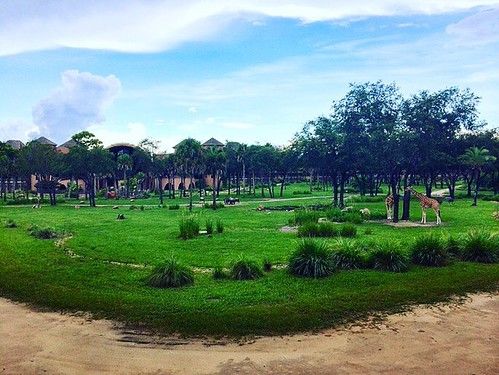
One DVC contract at Animal Kingdom Lodge covers two buildings, Jambo House and Kidani Village, and you can book either one at the 11 month home resort window. That's the first thing to know, because a lot of people looking at resale listings assume they have to pick a side before they purchase. You don't.
Disney calls the home resort Disney's Animal Kingdom Villas. Jambo House is the original lodge, the one with the big thatched lobby, where the villas share the building with regular hotel rooms. Kidani Village is a separate building a short drive down the road, and it's all villas. Both look out over savannas with giraffes, zebras and other animals, and both sit under the same contract, the same points, the same dues and the same 2057 end date. Each building does have its own column on the points chart, so the cost of a night isn't identical between them. Your points also work at the other DVC resorts at the 7 month window, same as any membership.
Jambo House or Kidani Village
Jambo House feels like a hotel. You walk into the main lobby, the restaurants are right there (Boma and Jiko are both in this building), and there's a lot more coming and going. Some people enjoy that. Others find it busy.
Kidani Village is quieter. It has its own pool, its own savanna and its own restaurant, Sanaa, with big windows facing the animals. Because Kidani was built as villas from day one, the whole place feels more like a condo building than a hotel. If you asked me which one I'd pick for a family settling in for a full week, I'd say Kidani. For a couple who likes the energy of a hotel lobby and wants to walk to dinner at Jiko, Jambo House makes more sense.
Plenty of owners like both and split their stays between them. And since one contract books either building, you don't have to settle the question now.
Room types are the usual lineup at both buildings: studios, one bedroom villas, two bedroom villas, and three bedroom grand villas at the top end. The grand villas take a lot of points. Most families we work with book studios or one bedroom villas, and some book a two bedroom when grandparents come along.
Savanna views cost more points
Both buildings sell rooms by view, and the savanna view rooms cost more points per night than the standard view rooms facing the parking lot or the pool. It's the biggest choice you'll make every time you book here. It's hard to put a price on a giraffe outside the window, though the points chart certainly tries.
Waking up to animals off the balcony is the reason a lot of families choose this resort in the first place. But if you're out at the parks from opening until the fireworks, a standard view stretches your points further, and you'll be on a bus most mornings anyway. I'd look at the points chart for the weeks you actually travel before deciding how many points you need. A family that wants savanna view on every trip needs a larger membership than a family that's happy with standard, and the difference adds up across a seven night stay.
We'd rather you purchase the right size once than come back two years later looking for a second, smaller contract to cover the gap.
There are two tools that help when one trip needs more points than one year gives you. Points you don't use can be banked into the following year if you bank them before the deadline, and you can borrow from next year's points too. A family that wants a savanna view two bedroom every other year can plan around that instead of owning enough points to do it annually.
Owning here also gives you first crack at those rooms, because you can book at 11 months while owners from other resorts wait until 7.
Getting around is the tradeoff
Animal Kingdom Lodge sits out near Animal Kingdom park, well away from Magic Kingdom and EPCOT. There's no monorail, no boat and no Skyliner here. You ride Disney buses or you drive.
The buses work fine. They run to all four parks and Disney Springs, and Animal Kingdom park is a short ride. Still, Magic Kingdom is a long trip from this corner of the property, and on a hot afternoon with tired kids that matters more than it does on paper. If you like to go back to the room midday for a nap or a swim, count the ride in both directions. A lot of owners drive their own car or rent one for the week, which takes most of the sting out of it.
So who is this resort for? Families who enjoy the resort itself. People who see the lodge as part of the vacation, who'll spend a slow morning on the balcony, eat dinner at the lodge, and take a pool day without feeling like they wasted a park ticket. Anyone who likes animals, obviously. Families with younger kids who need a break from the parks tend to do well here too.
And who should look elsewhere? If your plan is to be at the Magic Kingdom gate first thing every morning, or you want to walk to EPCOT for dinner, you'll probably be happier at a resort on the monorail, the boats or the Skyliner. I'd tell you that before you purchase, not after. Animal Kingdom is a great resort for the right family, and a frustrating one for a family that spends twelve hours a day in the parks.
What it costs to own
Annual dues at Animal Kingdom Villas are $10.16 per point for 2026. That's on the higher side for Walt Disney World. Grand Floridian runs $8.31, Copper Creek $9.02 and Saratoga Springs $9.19. On a 150 point contract you're looking at about $1,524 a year in dues here. You can compare every resort on our annual dues page.
The contract runs to 2057, so a membership purchased now has a little over 30 years left. That's a healthy stretch. It's shorter than Polynesian (2066) or Riviera (2070) and a good deal longer than Boardwalk or Beach Club, which both end in 2042.
Disney sells Animal Kingdom points directly for $210 per point in 2026. On the resale side, our paid closings over the last 12 months averaged $108 per point across 24 sales, with a range of $97 to $125. So a resale membership here has been selling for roughly half of Disney's price.
In dollars, 150 points at Disney's $210 comes to $31,500. The same 150 points at our $108 average is $16,200. That's a $15,300 difference for the same rooms and the same 2057 end date. The buyer also pays Disney's $500 Club Activation Fee on a resale purchase, which barely dents that gap.
The savings come with a catch, though. Points purchased directly from Disney carry some member benefits a resale contract doesn't, and resale contracts at the original resorts (Animal Kingdom included) purchased after January 19, 2019 come with booking restrictions at the newer resorts. We keep the full rules on our resale restrictions page rather than repeating them here, because they're the kind of thing you should read in full. For a family that plans to stay mostly at Animal Kingdom and the other original resorts, we think the resale savings win easily.
Contract size and price per point
Smaller contracts usually sell for more per point. Over the last 24 months of our paid closings at Animal Kingdom, contracts under 100 points averaged $120 per point (6 sales), contracts from 100 to 149 points averaged $106 (10 sales), and contracts of 150 points or more averaged $103 (25 sales). Six sales is a small sample, so don't lean too hard on that $120 figure. The pattern holds at most resorts. More families can afford a 75 point contract than a 250 point one, so the small ones draw more buyers. You pay more per point but less in total.
Three things set the price of a contract on the secondary market: the resort, the point count, and how many points are currently available on it. A contract with a full set of current points ready to book is worth more than the same size contract that's already been mostly used this year. That's the whole list.
Prices move, and a 12 month average hides the swings from one month to the next. For the latest numbers, check our DVC market report. If you want to see what's for sale at both buildings today, our current listings show every Animal Kingdom contract we have.
If you own here and you're thinking of selling
Animal Kingdom is one of the busier resorts on our books, and its 24 sales in the last 12 months trail only Saratoga Springs (26). Steady demand helps a seller.
Our commission is 6.9%, against an industry average of about 9.5%, and the seller pays Disney's $150 estoppel fee. Once a buyer signs, Disney has up to 30 days to decide on its right of first refusal, and over the last 12 months its answer came back in about 21 days on average. If Disney does exercise ROFR, nothing changes for you. Same price, same commission, same proceeds, with Disney taking the buyer's place. We typically close in about 45 days from the signed agreement, and within 5 to 10 days once Disney waives its right of first refusal.
If you'd like a number for your own contract, start on our selling page and we'll take it from there.







Got Something on Your Mind?
Your email address will not be published. Required fields are marked *