


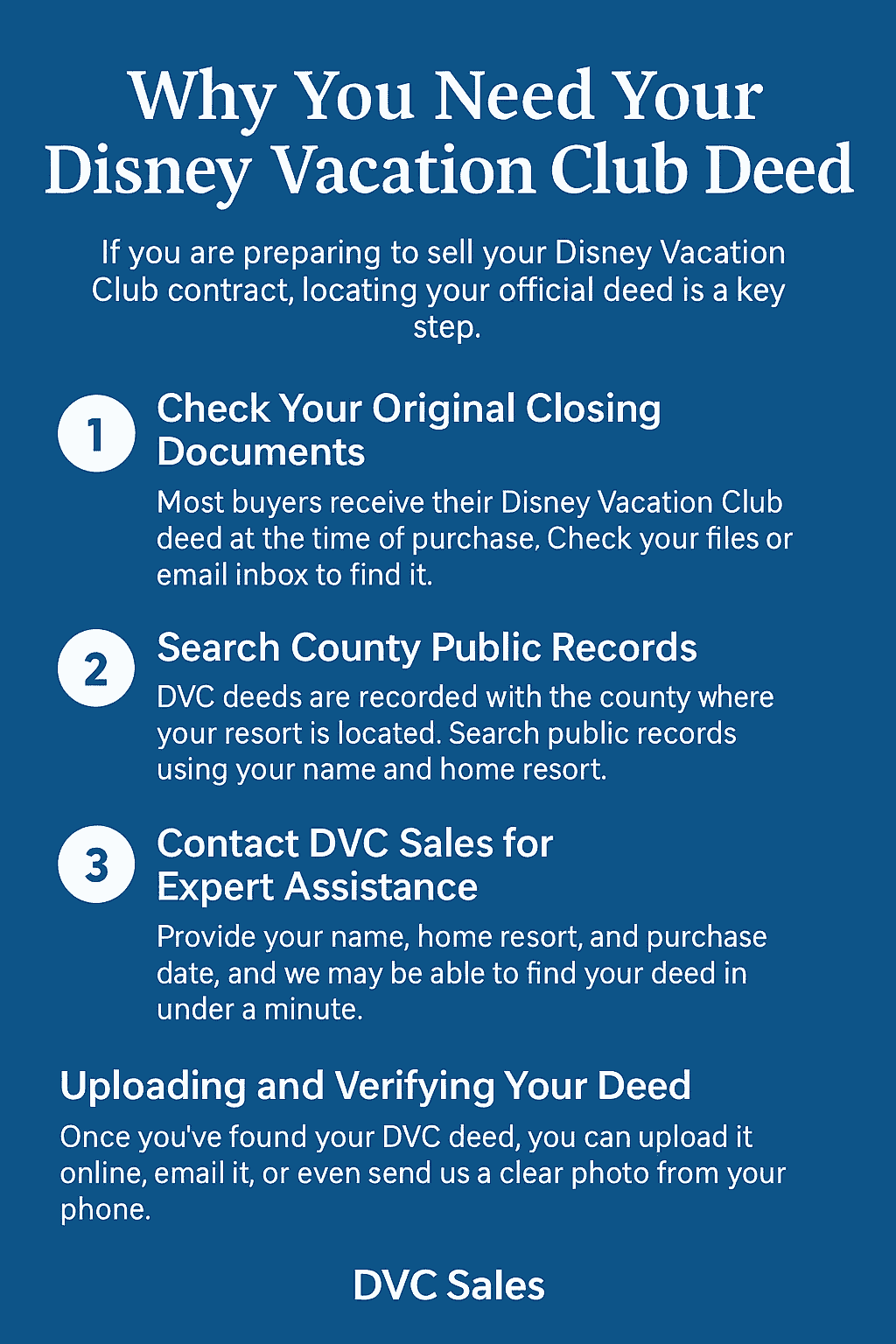
Why You Need Your Disney Vacation Club Deed

When you're preparing to sell your Disney Vacation Club membership, locating your official deed is one of the first essential steps. The deed serves as legal proof of your ownership and contains the specific details that buyers and title companies need to complete the transaction. Without it, the resale process can't move forward.
Your deed contains critical information including your exact point allocation, home resort, use year, and contract expiration date. This information determines your membership's value and helps potential buyers understand exactly what they're purchasing. The good news is that accessing your Disney Vacation Club deed is typically straightforward, even if you can't locate your original copy.
How to Find Your Disney Vacation Club Deed
1. Check Your Original Closing Documents
Most DVC owners receive their recorded deed shortly after their purchase closes, whether they purchased directly from Disney or through the resale market. The deed might have arrived by mail, email, or through a secure online portal provided by the title company.
Start by searching your files for anything labeled "closing packet," "recorded deed," or correspondence from the title company that handled your transaction. If you purchased recently, check your email inbox using search terms like "deed," "recording," or your resort name. Many title companies now provide digital copies, so you might find a PDF version in your email.
If you purchased directly from Disney, they typically mail the recorded deed to you within 30-60 days after closing. For resale purchases, the timeframe depends on the title company, but it's usually similar.
2. Search County Public Records
Every Disney Vacation Club deed gets recorded with the county where your resort is located, and these records are public. This means you can access a copy of your deed online through the appropriate county recorder's office.
The process varies slightly by county, but you'll typically need your name, home resort, and approximate purchase date to search effectively. Some counties require you to know the exact spelling of names as they appear on the deed, while others are more flexible with search parameters.
For example, if you own at Disney's Polynesian Villas & Bungalows or Bay Lake Tower at Disney's Contemporary Resort, you'd search Orange County, Florida records. Disney's Hilton Head Island resort deeds are recorded in Beaufort County, South Carolina, while Vero Beach deeds are in Indian River County, Florida.
Most county websites offer free deed searches, though some charge a small fee (usually $1-5) to download or print copies. The digital copies you find through county records are legally equivalent to the original deed you received at closing.
3. Contact Your Title Company
If you remember which title company handled your purchase, they can often provide a copy of your recorded deed. Keep the contact information for your title company in your DVC files, as they're a valuable resource for various ownership questions that might arise over the years.
Title companies maintain records of transactions they've handled and can usually email you a digital copy quickly. You'll need to provide identifying information like your name, resort, and approximate closing date.
4. Let DVC Sales Help You
If you'd prefer not to search on your own, we're here to help. We maintain direct links to county recorder websites for every Disney Vacation Club resort and can often locate your deed in minutes.
Simply provide us with your name as it appears on the deed, your home resort, and your approximate purchase date. We know exactly which county office handles records for each resort, and we're familiar with the search interfaces for these various systems.
This service is part of our commitment to making the resale process as smooth as possible for our sellers. There's no charge for this assistance, and it ensures you have the correct deed information for your resale listing.
What Your DVC Deed Contains
Your Disney Vacation Club deed is the legal document that establishes your ownership interest in your home resort. Understanding what information it contains helps explain why it's so important for the resale process.
The deed specifies your exact point allocation, which determines the size of your ownership interest. It also identifies your home resort, use year (the month your new points are allocated each year), and the contract expiration date.
Additionally, the deed contains legal descriptions of the property, information about any restrictions or covenants that apply to your ownership, and details about your voting rights as a member of the vacation club.
For resale buyers, the deed confirms they're purchasing exactly what the seller claims to own. For sellers, it provides the definitive source of information needed to create an accurate listing.
Different Types of DVC Deeds
Not all Disney Vacation Club deeds look identical. The format can vary depending on when you purchased, whether you bought direct from Disney or resale, and which resort you own.
Older deeds might have different formatting or legal language compared to more recent ones. Deeds for Disney's Riviera Resort and Disney's Polynesian Villas & Bungalows, for example, reflect the more recent legal structure Disney uses for newer resorts.
Some members own multiple contracts at the same resort, which means they'll have separate deeds for each purchase. If you've added on to your membership over time, make sure you locate deeds for all your contracts.
Resale deeds and direct purchase deeds contain the same essential information, but the recording process and deed preparation might involve different entities depending on your purchase path.
Uploading Your Deed for Resale
Once you've located your Disney Vacation Club deed, getting it to us is simple. You can upload a digital copy through your seller dashboard on our website, email it directly to our team, or even send a clear photo taken with your smartphone.
We accept deeds in various formats: PDF files, photos, scanned images, or even clear smartphone pictures. The key is making sure all the text is readable and the entire document is captured.
If you only have a physical copy, don't worry about getting it professionally scanned. A well-lit photo taken with your phone often works perfectly fine, as long as you can read all the details clearly.
What Happens After You Submit Your Deed
Our team reviews every deed submission to verify the ownership details match what you've told us about your membership. We check the point allocation, home resort, use year, and contract expiration date to ensure accuracy.
This verification step is important because it prevents listing errors that could cause problems later in the resale process. We want to make sure potential buyers see exactly what you're selling, with no discrepancies between your listing and your actual ownership.
If we spot any inconsistencies or have questions about your deed, we'll reach out to clarify before your listing goes live. This attention to detail helps create a smoother transaction for both you and your eventual buyer.
Why Deed Verification Matters
Accurate deed verification protects both sellers and buyers in the resale market. For sellers, it ensures your listing reflects your actual ownership, which prevents buyer disappointment and potential legal issues down the road.
For buyers, verified deed information provides confidence that they understand exactly what they're purchasing. This transparency helps build trust in the transaction and reduces the likelihood of disputes during the closing process.
The verification process also helps us price your membership appropriately for the current market. Point values can vary based on use year, contract expiration date, and other factors that appear on your deed.
Common Issues and Solutions
Sometimes sellers run into specific challenges when trying to locate their deed. Here are some common situations and how to address them:
If you've moved since purchasing your membership, the deed might have been mailed to your old address. In this case, county records become your best option for obtaining a copy. The recorded deed is always available through public records, regardless of where the original was mailed.
If you purchased your membership as part of a divorce settlement or inheritance, the deed might be under someone else's name initially. You may need additional documentation showing the transfer of ownership to your name.
For members who purchased decades ago, older deeds sometimes have different formatting or might be filed under slightly different naming conventions in county systems. Our team has experience with these variations and can often help locate older deeds even when standard searches come up empty.
If you've refinanced your DVC membership or taken out a loan against it, there might be additional documents recorded alongside your original deed. Don't worry if you see multiple entries in county records, this is normal for financed purchases.
Planning Your Resale Timeline
Locating your deed is typically the first step in selling your Disney Vacation Club membership, but it's worth understanding how it fits into the overall timeline. Once you have your deed and submit it for verification, we can usually get your listing live within 1-2 business days.
The resale market moves at different speeds depending on factors like your home resort, point allocation, use year, and asking price. Popular resorts with desirable contract terms often sell faster than others. We provide current market data to help you set realistic expectations for your specific membership.
Starting the process early gives you flexibility in timing and pricing. If you're not in a hurry to sell, you might choose to list at a higher price and wait for the right buyer. If you need to sell quickly, understanding current market conditions helps you price competitively from the start.
Making the Process Smoother
Beyond locating your deed, there are several steps you can take to streamline your resale experience. Organizing all your DVC-related documents in one place makes it easier to find what you need throughout the selling process.
Keep records of your annual dues payments, any special assessments you've paid, and documentation of any points you've banked or borrowed. While the deed is the primary document needed to start your listing, these other records can be helpful if questions arise during the transaction.
If you've made any modifications to your membership over the years, such as converting to a different use year or adding points through Disney's direct sales, make sure you understand how these changes affect your ownership. These modifications should be reflected in your most recent deed or in additional recorded documents.
Consider reviewing your current dues obligations and understanding what transfers to the buyer versus what remains your responsibility. This knowledge helps you answer buyer questions confidently and ensures a smoother closing process.
We're here to guide you through every step of selling your Disney Vacation Club membership. Whether you need help locating your deed, understanding current market conditions, or navigating the closing process, our experience with hundreds of DVC resale transactions helps ensure your sale goes smoothly.
If you have questions about your specific situation or want to get started with your resale listing, we're ready to help. Our goal is making the process as straightforward as possible while ensuring you get fair value for your membership.






Got Something on Your Mind?
Your email address will not be published. Required fields are marked *