


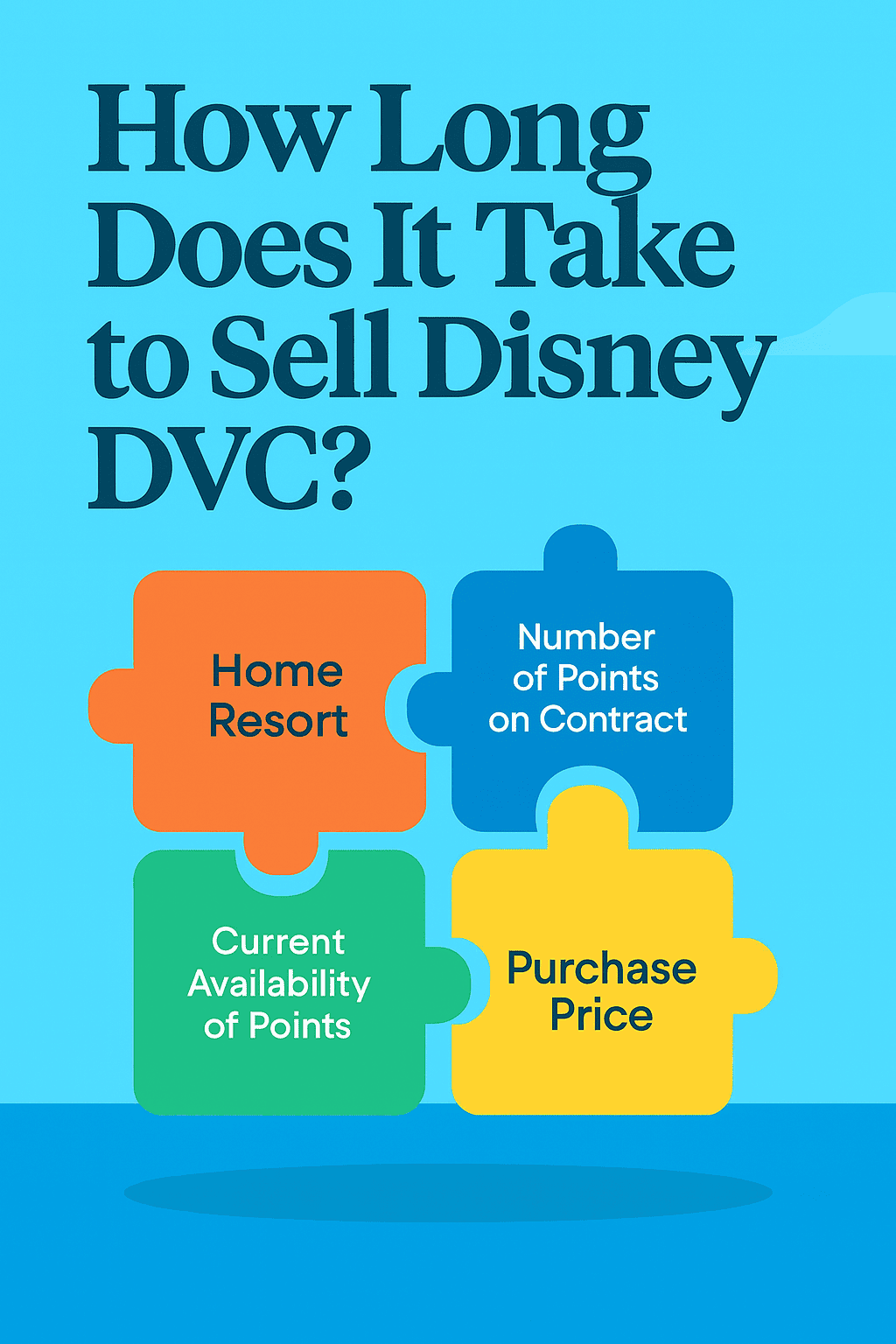
How Long Does It Take to Sell a DVC Membership?
The realistic answer for most sellers is that a well-priced DVC contract goes under contract within two to four weeks of listing. After that, there is a 30-day window for Disney's Right of First Refusal review, followed by a two to four week closing process handled by the title company. All in, you are looking at roughly 60 to 90 days from the day your listing goes live to the day ownership transfers and you receive your proceeds.
That is the typical range for a contract priced to compete. Overpriced listings can sit for months, sometimes indefinitely. The same DVC membership at the same resort can sell in three weeks or sit for six months depending almost entirely on the asking price. After 25 years of handling DVC resale transactions, that pattern holds up consistently across every resort in the portfolio.
The Three Things That Control Your Timeline
Three variables determine how quickly your listing attracts an offer: price, resort demand, and available points. Of those three, price is the only one you control after the listing goes live.
Resort demand matters because some DVC properties generate more buyer interest than others. Beach Club, Polynesian, and Boardwalk consistently attract buyers who are specifically targeting those resorts because of their location and booking advantages. A Beach Club contract priced well can sometimes attract an offer within days. A contract at a less sought-after resort priced equally well might take a couple of weeks. The demand difference is real, but it does not override pricing. A well-priced contract at any WDW resort will sell. An overpriced contract at any resort will stall.
Available points matter because they represent immediate value to the buyer. A contract with banked points, a full current-year allotment, and a clean upcoming year is more attractive than a contract where the points have been largely consumed for the year. Buyers want to start vacationing after closing, and more available points means a faster path to booking. If your contract has limited availability because of trips you have taken recently, pricing should reflect that.
How Buyers Find Your Listing
Buyers browsing the DVC Sales listings page typically start by selecting a resort, then sort results by value. The listings that appear at the top of that sorted view are the ones receiving the most attention and generating the most offer activity. If your contract is ranked outside the top 8 for your resort, it is likely being overlooked in favor of better-priced alternatives.
You can see your exact ranking in Section 3 of the View Details page in your seller dashboard. That ranking is calculated in real time based on price per point and available points. Check it regularly, because as other listings get updated or go under contract, your position in the rankings shifts.
The ROFR Review Period
After both the buyer and seller sign the purchase agreement and the buyer submits their deposit, the contract goes to Disney for their Right of First Refusal review. Disney has 30 days to decide whether they want to purchase the contract themselves at the agreed price. This period is essentially unavoidable in DVC resale. It applies to every transaction regardless of resort, price, or buyer.
Disney exercises ROFR on roughly 15 to 20 percent of contracts submitted to them, and they tend to focus on contracts priced below the current market rate. If your contract is priced at or near fair market value, the likelihood of Disney stepping in is relatively low. If you accepted a significantly below-market offer, ROFR risk goes up.
When Disney passes on ROFR, which happens the majority of the time, the transaction moves immediately to the title company for closing. There is no additional waiting period or re-review. It is a clean handoff.
What Happens If Disney Exercises ROFR
If Disney decides to exercise their right, they purchase the contract at the same price the buyer agreed to. For the seller, the outcome is identical: you receive the agreed sale price. For the buyer, it means a full deposit refund and the need to find a different contract.
This is not a common outcome, but it does happen. If it happens to you as a seller, you are in the same position you started from: free to relist and find a new buyer. If it happens to you as a buyer, DVC Sales will help you find comparable listings at the same resort as quickly as possible.
The Closing Process After ROFR Passes
Once Disney issues its ROFR waiver, the title company takes over. The title agent prepares the new deed transferring ownership from seller to buyer, coordinates with Disney on the processing of the $150 Estoppel Fee paid by the seller and the $500 Administration Fee paid by the buyer, and handles the recording of the deed with the appropriate county.
This phase typically runs two to four weeks. The exact duration depends on how quickly both parties provide required documentation and on the processing time at the county recorder's office. Once the deed is recorded, the seller receives their proceeds and the buyer is recognized as the new owner in Disney's system.
The buyer usually receives their new DVC member credentials from Disney within one to two weeks after the deed recording. That is when they can log into their Disney Vacation Club account, see their points, and start booking stays at their home resort and beyond.
How to Speed Up the Process
The most effective way to shorten your selling timeline is to price your contract competitively from the start. A listing that generates an offer in week one or two will close weeks earlier than one that sits without activity and requires price reductions before attracting interest.
Having your documentation ready also helps. Sellers who provide clean deed information, a clear point breakdown, and proof images upfront give buyers the information they need to make an offer without asking a lot of back-and-forth questions. That speed of information exchange translates to faster offers and fewer delays in the negotiation phase.
Once an offer is accepted, responding quickly to any requests from the title company is the seller's best contribution to keeping the closing on schedule. Most delays in the closing phase come from waiting on one party or the other to return paperwork. Being responsive to title company requests can shave days off that process.
If Your Listing Has Been Active for More Than Three Weeks Without Offers
Three weeks without activity on a listing is a signal worth taking seriously. Check your Section 3 ranking. If you are not in the top 8 for your resort, a price adjustment is probably overdue. Even a modest reduction of $4 to $6 per point can change your competitive position meaningfully.
Also look at whether any comparable contracts at your resort have gone under contract since your listing went live. If similar contracts are selling and yours is not, the only real difference is usually price. The market is telling you something, and adjusting early produces better outcomes than waiting.
What Buyers Experience During the Same 60 to 90 Days
While sellers are tracking their listing activity and waiting for offers, buyers who have already submitted an offer and gotten it accepted are going through a parallel process. Understanding what a buyer experiences can help sellers calibrate their expectations about buyer motivation and timeline sensitivity.
After an accepted offer, buyers sign the purchase agreement, submit their deposit, and then wait for the ROFR period to clear. During that 30-day wait, they cannot do anything to move the process forward. They are simply hoping Disney passes on the contract so the transaction can proceed. For motivated buyers who have been searching for the right contract at the right resort, that 30-day window feels long. They are excited about a contract they have committed to and have no ability to expedite the timeline.
After ROFR clears, the closing phase begins. The title agent is in charge, and both parties wait on deed preparation, fee processing, and county recording. For buyers who close in 60 days total, the experience is smooth. For those whose closings stretch toward 90 days due to county recording backlogs or documentation delays, the wait can test patience.
Sellers who are responsive to title company requests during the closing phase directly affect how long their buyers wait. A seller who takes four days to return a document request adds four days to the buyer's timeline. That kind of friction is avoidable and worth avoiding both because it is courteous and because delays in your own proceeds are the consequence on the seller side.
Points Expiration and How It Affects Timing
One aspect of the selling timeline that sellers sometimes overlook is the expiration structure of their points. DVC points can be banked for one year beyond the use year they are allocated to. Once banked, they must be used by the end of the following use year or they expire. Points that expire have no value and cannot be transferred to the buyer.
If your contract has banked points that are approaching their expiration date and your listing has not sold yet, the clock on those points is running. A contract that starts the selling process with 300 available points might arrive at closing with only 150 if the banked points expire before the deal closes. That is a significant value reduction for the buyer and will likely cause pricing complications mid-transaction if it is not anticipated and disclosed.
When you are setting up your listing, be clear about any banked points and when they are scheduled to expire. If there is a risk that those points might not survive the 60-to-90-day transaction timeline intact, that needs to be in the listing details and factored into your pricing. Buyers deserve to know what they are actually getting, and a surprise points expiration after an offer is signed is the kind of thing that damages trust and sometimes unravels deals.
The Decision to List Now vs. Wait
Some sellers wonder whether they should list immediately or wait for a more favorable market period. The honest answer is that market timing is difficult and rarely as impactful as pricing in determining how quickly a contract sells. A well-priced contract listed in July will typically sell faster than an overpriced contract listed in March during peak buyer season.
That said, if you know your points are going to be significantly depleted by a trip you have planned in the next two months, waiting until after the trip to list with a fresh point allotment can strengthen your listing value. Points available at listing are one of the first things buyers evaluate, and a fully loaded contract commands a better price than one where most of the current year has been consumed.
For context on how resale prices compare to what Disney charges for new contracts, see our DVC retail prices page. And if you want to understand your ongoing annual costs as a seller or as a buyer evaluating the full ownership picture, our annual dues page breaks that down by resort. Ready to list? Our team is available through the contact page to help you set a competitive price and get started.

