


Confirming Available DVC Points
Confirming available DVC points is a critical step in every Disney Vacation Club transaction. The number of points listed in your purchase agreement must match what is actually available at closing, which protects both the buyer and the seller from costly surprises. At DVC Sales, we have handled this verification process thousands of times and can walk you through exactly what to expect.
Points verification sounds like a formality, but it is genuinely one of the most important steps in the closing process. DVC contracts are priced in large part on the points they carry. If you are paying for 200 points and only 150 are available at closing, that is a meaningful financial discrepancy. The verification step exists specifically to catch and correct situations like that before any money changes hands.
Why Point Verification Protects Your Investment
When you purchase a Disney Vacation Club contract, the DVC points described in your agreement should reflect the actual balance available at closing. This verification prevents issues like borrowed points that were not disclosed at listing, recently used points that reduce the available balance, or banking decisions that change what will transfer with the contract.
The title company verifies the point balance before transferring the deed. This is not a formality. It is a safeguard that ensures you receive exactly what was promised in your contract. We have seen transactions pause at this stage when point balances do not match, and that protection is worth the extra step for everyone involved.
For buyers who are planning to use their new points immediately, this verification is especially important. The last thing you want is to discover missing points after you have already scheduled a Disney resort trip and are counting on those points being available.
What Sellers Need to Provide
If you are selling your DVC contract, you need to confirm that your current point balance has not changed since signing the purchase agreement. This means no points used for reservations since the contract was signed, no points borrowed from future use years that were not disclosed in the original listing, and no points banked or transferred that are not reflected in the agreed-upon contract terms.
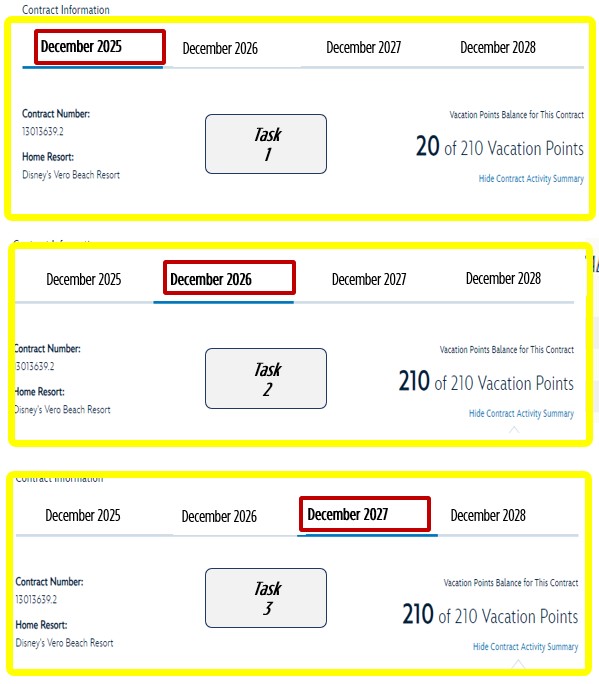
The title company will typically ask you to log into your Disney Vacation Club account and download a current point statement. Sometimes a screenshot of your member dashboard is sufficient. This documentation shows your current balance, any banked points from previous years, and any points already borrowed from future use years.
The process is straightforward, but timing matters. Do not make any changes to your point balance after signing the purchase agreement. If you need to use points for an upcoming trip, talk with our team at DVC Sales before proceeding. Making reservations after signing a contract can create complications that delay or derail the closing.
If you accidentally used points after signing, the situation is not necessarily a deal-breaker. But you need to disclose it immediately so the buyer and title company can decide how to handle it. Options typically include a price adjustment to account for the reduced balance or, in some cases, waiting for additional points to become available. Trying to hide it is never the right move.
How Point Verification Protects Buyers
As a buyer, this verification step gives you confidence that you will receive every point you paid for. When the point balance comes in lower than expected, you have options depending on your contract terms. You may be entitled to a credit for the missing points, a price adjustment, or in some cases the right to cancel the transaction entirely.
This protection is particularly important if you are purchasing close to your planned vacation dates. But it matters even if you are not planning to use the points immediately. You are paying for a specific number of points, and those points are part of the value you are acquiring. Getting what you paid for is not optional.
For more information about how DVC points work, including banking, borrowing, and use year rules, visit our How DVC Works page. Understanding the full points system helps you evaluate contract details more accurately when you are considering a purchase.
The Title Company Verification Process
The title company handles the actual verification, but they need cooperation from the seller to access current point information. Here is how it typically works in practice.
First, the title company requests a current point statement from the seller, usually within a few days of the planned closing date. This ensures the information is as current as possible before funds change hands. The seller logs into their DVC account, downloads the statement, and sends it to the title company.
Next, the title company reviews the statement against the purchase agreement. They are looking at the total point balance, including current year points, any banked points from previous years, and any borrowed points from future use years. Each of these categories affects what the buyer will actually receive.
If everything matches, the closing proceeds as planned. If there is a discrepancy, the title company pauses the transaction until the issue is resolved. This might involve getting an updated statement, adjusting the purchase price, or in rare cases, canceling the transaction. The title company acts as a neutral party in this process, which protects both sides.
Common Point Balance Issues That Come Up
Most point verifications go smoothly, but certain situations come up more than others. Borrowed points are the most frequent issue. If a seller borrowed points from a future use year to make a recent reservation, those borrowed points reduce the balance available to the buyer at closing. Whether borrowed points were disclosed in the original listing matters a lot here.
Banking deadlines can also create confusion. DVC members can bank unused points from one use year to the next, but there are specific deadlines and restrictions. If points were recently banked, or if banking deadlines have passed and points that were expected to be available were lost instead, the available balance might differ from what was originally listed.
Recent point usage is another potential issue. If the seller made a reservation after signing the purchase agreement, those points are no longer available for the buyer. This is why sellers should avoid using points once the contract is signed. Good intentions do not undo the accounting impact.
These issues are not necessarily deal-breakers. In our experience, most discrepancies can be resolved through price adjustments or updated documentation. The key is catching them during verification rather than after closing when options are much more limited.
Getting Help With Point Verification
If you are not sure how to access your DVC point balance or download a statement, the process is simpler than it might seem. Start by logging into your Disney Vacation Club member account online. Your point balance and activity are displayed on the main dashboard. You can download detailed statements that show your complete point history, including current balances, banked points, and any borrowed points.
The DVC Sales team can walk you through this process if you need assistance. We can also coordinate with the title company to ensure they receive the documentation they need in the proper format. Call us or reach out through our contact page and someone will help you get sorted quickly.
For buyers who want to understand more about DVC point systems before closing, our How DVC Works page provides detailed information about point allocation, banking, borrowing, and usage rules. The more you understand about how the system works, the better equipped you are to evaluate what you are buying.
What Happens When Points Do Not Match
Let us say the verification comes back and the seller has 180 points available instead of the 200 points listed in the contract. How does that get resolved?
The most common resolution is a price adjustment. If you paid $X per point, you would receive a credit at closing equal to the 20 missing points multiplied by the per-point price. This keeps the transaction moving and ensures you pay only for what you actually receive.
Some buyers prefer to walk away from transactions where the points do not match, particularly if they were planning to use all the points immediately for an upcoming trip. That is a legitimate response, and a well-drafted purchase agreement should give you that option. Our contracts at DVC Sales are written to protect buyers in exactly this scenario.
In rare cases, the discrepancy is significant enough that the buyer decides a price adjustment is not sufficient and cancels the transaction entirely. This is uncommon, but it does happen. The deposit handling in that scenario depends on the specific contract terms and what caused the discrepancy.
Banked Points and What They Mean for You
Banked points from a prior use year can add real value to a contract, but they also come with important conditions. Banked points must be used before the end of the use year they were banked into. If a seller is passing along banked points as part of the contract, the buyer needs to understand exactly when those points expire and plan accordingly.
For example, if a contract has a December use year and the seller has banked 100 points from the previous use year into the current one, those 100 banked points expire at the end of the current December use year. If the contract is closing in October and the buyer does not have a trip planned before December, those points may be difficult to use in time.
This is not necessarily a problem, but it is something buyers should understand clearly before closing. The verification process confirms these banked points exist. What you do with them once you own the contract is up to you, but planning around expiration dates is important for getting full value out of every point you purchase.
Moving Forward With Confidence
Point verification might seem like an extra step, but it is one of the most important protections in the entire DVC resale process. Sellers close knowing they have fulfilled their obligations accurately. Buyers close knowing they are receiving exactly what they paid for. And the title company has a clean record showing the verified balance that transferred with the deed.
This verification is one of the final steps before your DVC contract closes. Once the point balance is confirmed and all other closing requirements are met, the deed transfer can proceed and you will officially become a Disney Vacation Club member or successfully complete your sale.
At DVC Sales, we have guided thousands of families through this process. With experienced title companies and proper documentation, point verification is typically straightforward and gives everyone confidence that the transaction is accurate and complete. Browse our current DVC resale listings or reach out through our contact page if you have questions about a specific contract.

