


DVC HARPTA Tax: Selling Your Aulani Contract as a Non-Hawaii Resident
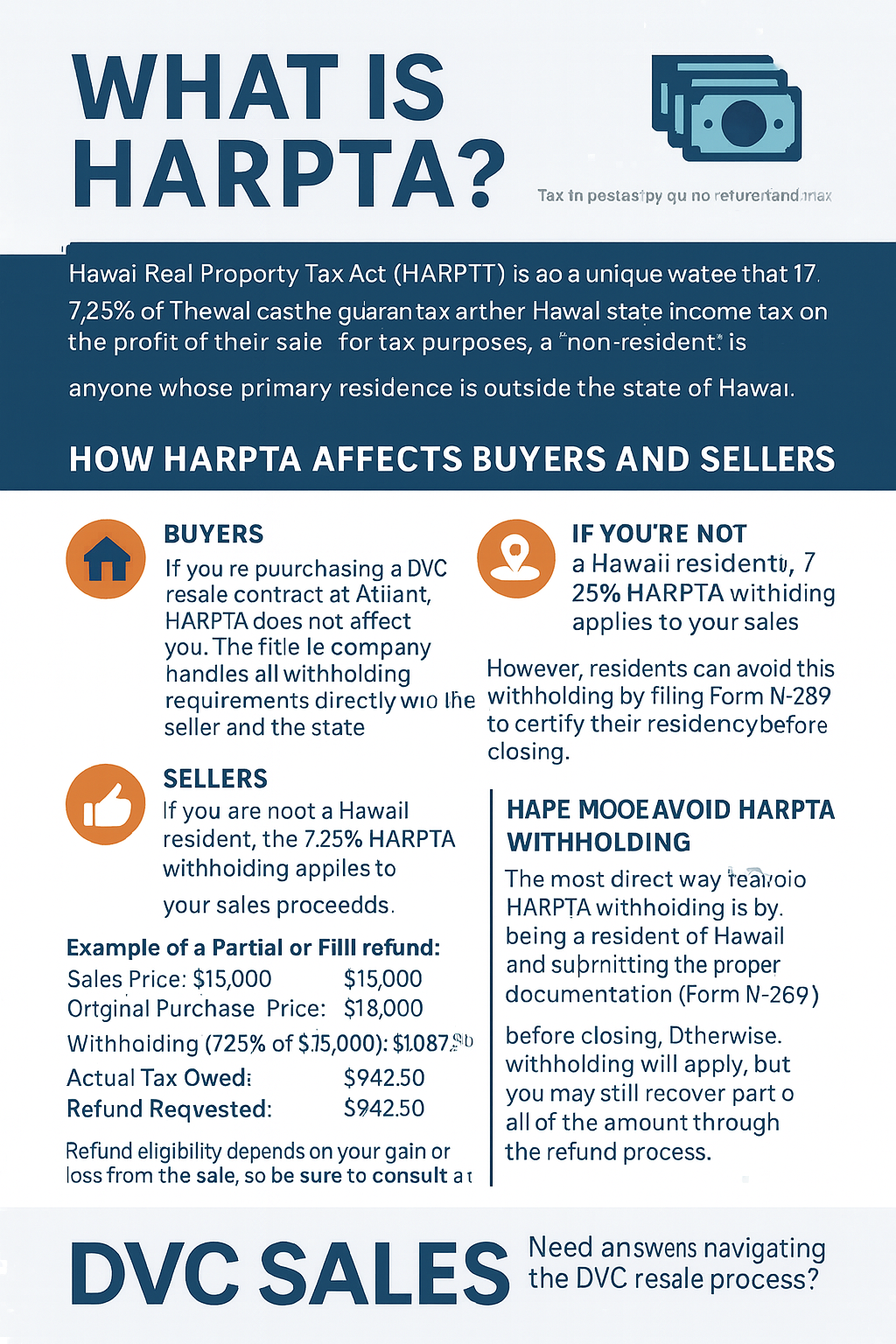
When you are selling or purchasing a Disney Vacation Club contract at Aulani, Hawaii HARPTA tax can affect your transaction. HARPTA stands for Hawaii Real Property Tax Act, and it requires a 7.25% withholding from the gross sales price for non-resident sellers of Hawaiian real estate. Since Aulani DVC contracts are classified as real property under Hawaii law, HARPTA applies to these transactions the same way it applies to any other Hawaiian real estate sale.
We have guided hundreds of families through DVC transactions involving HARPTA, and our dedicated resource at dvcharpta.com provides clear guidance for sellers navigating these requirements. The rules are specific, and getting them right at the start saves a lot of headache later.
What Is the HARPTA Tax for DVC
HARPTA is not a penalty or an additional tax on top of your normal obligation. It is a withholding system that requires 7.25% of your gross sales price to be set aside and sent to the Hawaii Department of Taxation at closing. Think of it as a prepayment toward any potential capital gains tax you might owe to Hawaii on the sale.
This withholding applies when you are selling DVC points at Aulani and you do not qualify as a Hawaii resident for tax purposes. The law affects both U.S. residents living in other states and international sellers. If federal FIRPTA also applies to your transaction, HARPTA typically does not apply simultaneously, but determining which law governs your specific situation requires a careful review of your circumstances. These are two separate withholding regimes and which one applies depends on your residency and citizenship status.
Who Must Deal With HARPTA
Any seller who does not meet Hawaii residency requirements may be subject to HARPTA when selling an Aulani contract. This includes people who live in other U.S. states and international owners. Hawaii residency for HARPTA purposes is different from residency for voting or driver licensing purposes. You need to have maintained Hawaii as your primary domicile and meet specific income tax filing requirements in Hawaii to qualify as a resident and avoid HARPTA withholding.
The buyer in your transaction is legally responsible for ensuring the withholding is collected and properly submitted to Hawaii tax department. That responsibility creates potential complications if not handled correctly. Buyers who fail to withhold when required can face penalties and become personally liable for the tax. Sellers can experience closing delays or discover unexpected tax obligations later if the process is handled improperly.
This is why working with a title company that has specific experience handling Aulani DVC transactions matters. Not every title company handles these regularly, and a company unfamiliar with HARPTA can create delays and errors that are costly to fix after the fact.
Our HARPTA Support Resources
We have created comprehensive support for HARPTA situations through our dedicated resource at dvcharpta.com. This site walks you through the withholding requirements, explains how to complete Form N-289, and outlines the waiver process if you qualify for reduced or eliminated withholding.
Some sellers can avoid HARPTA entirely through proper documentation. Others might qualify for reduced withholding based on their specific tax situation, such as when the expected tax liability is demonstrably lower than the standard 7.25% withholding would produce. Applying for a reduced withholding certificate requires filing with Hawaii Department of Taxation before closing, so planning ahead is important.
We also maintain resources at DVC Sales for federal FIRPTA questions related to Aulani and other DVC resort sales. Having both state and federal tax requirements addressed correctly in your transaction prevents the most common complications that delay closings or create post-closing tax issues.
Why HARPTA Knowledge Matters Before You List
HARPTA affects three important aspects of your Aulani DVC sale: your net proceeds at closing, your closing timeline, and your future tax reporting obligations. The 7.25% withholding reduces the cash you receive at closing, though you may get some or all of it back when you file your Hawaii state tax return for the year of the sale.
More significantly, HARPTA mistakes can delay your closing or create tax complications that take months to resolve. We have handled thousands of DVC resale contracts and understand exactly how Hawaii requirements interact with the DVC transfer process. Knowing the HARPTA rules before you list means you can set realistic expectations for your net proceeds and closing timeline from the start.
Some Aulani sellers factor the potential HARPTA withholding into their listing price. If you know 7.25% will be withheld at closing and you may wait several months to recover some of it through a tax refund, pricing your contract to account for that cash flow difference makes practical sense. Our team can help you think through pricing with this consideration factored in.
The HARPTA Withholding Process at Closing
At closing, the title company handles the HARPTA withholding as a line item on your closing statement. The 7.25% is calculated based on the gross sales price, not your net proceeds after commission or other closing costs. This is an important distinction because it means the withholding is larger relative to what you actually take home than it might initially appear.
For example, if your Aulani contract sells for $30,000, HARPTA withholding would be $2,175. After our 6.9% commission of $2,070 and the $150 Disney estoppel fee, your proceeds before HARPTA withholding would be approximately $27,780. With HARPTA applied to the gross price, you would receive approximately $25,605 at closing, with the $2,175 sent to Hawaii Department of Taxation on your behalf.
If your actual Hawaii tax liability on the sale is less than $2,175, the difference comes back to you as a refund when you file your Hawaii tax return. But that refund takes time, so managing your expectations about the timing of your full net proceeds is important.
Qualified Withholding Certificates
If you believe your actual tax liability will be significantly less than the standard 7.25% withholding, you can apply to Hawaii Department of Taxation for a withholding certificate that authorizes a reduced withholding amount. This requires filing Form N-288B before closing and demonstrating your expected tax liability on the transaction.
The application process can take several weeks to process, so you need to start early if you want to pursue this route. Do not wait until you have a signed purchase contract to begin the application. If you know you are planning to list your Aulani contract, researching the withholding certificate option should happen before or during the listing period, not after you have an accepted offer.
Our team at dvcharpta.com has detailed guidance on the withholding certificate application process and can help you understand whether pursuing one makes sense for your situation.
HARPTA Compared to FIRPTA
Sellers who are not U.S. citizens or permanent residents may encounter both HARPTA and the federal FIRPTA withholding requirement. The two systems operate separately, and in most cases only one applies to a given transaction rather than both simultaneously. But the interaction between them can be confusing.
Generally speaking, if you are a foreign person selling an Aulani contract, FIRPTA applies at the federal level and requires 15% withholding. HARPTA provides an exemption for transactions where FIRPTA withholding applies. But if you are a U.S. citizen or resident living outside Hawaii, FIRPTA would not apply to you while HARPTA would still apply based on your non-Hawaii residency for state purposes.
Getting this determination right requires knowing your specific status and understanding how each law defines its covered sellers. A tax professional who handles both state and federal real estate tax matters is the right resource for making this call with certainty.
Transparent Fees and Expert Handling
We do not charge buyers any commission or fees beyond Disney standard $500 administration fee. Sellers pay our 6.9% commission plus clearly itemized closing costs. When HARPTA applies, the withholding appears as a clearly labeled line item on your closing statement and gets handled by our title company partners who specialize in these transactions.
Our approach through dvcharpta.com helps sellers understand Hawaii tax laws before listing, avoiding surprises at closing. Whether you need to prepare for standard withholding or pursue a qualified withholding certificate, you will know exactly what to expect throughout the process.
The combination of federal and state tax requirements can make Aulani sales more complex than other DVC resort transactions, but proper guidance removes the confusion. We will review your specific situation and connect you with the right resources to handle both the DVC transfer and any required tax compliance. Reach out through our contact page with any questions about your specific situation.
You can also explore our DVC resale listings to see how Aulani contracts are currently priced in the market, or visit our resort pages for more information about Aulani ownership and the benefits that come with it.

